

On March 24, 2026, USCIS published long-awaited data that revealed their official global EB-2 National Interest Waiver (NIW) approval rates from the fourth quarter of fiscal year 2025 (July to September 2025).
- EB-2 NIW approval rates have plummeted to 36%, making denials nearly twice as likely as approvals and signaling a fundamentally tougher adjudication environment.
- Exponential growth in EB-2 NIW filings versus PERM has likely prompted USCIS to tighten standards and reassert PERM as the default employment-based pathway.
- Applicants should reassess strategies, including E-2, O-1A, PERM, EB-5, or EB-1B, and seek expert legal guidance to build stronger, Dhanasar-compliant cases.
Only 36% of total NIW cases decided by USCIS in this period were approved
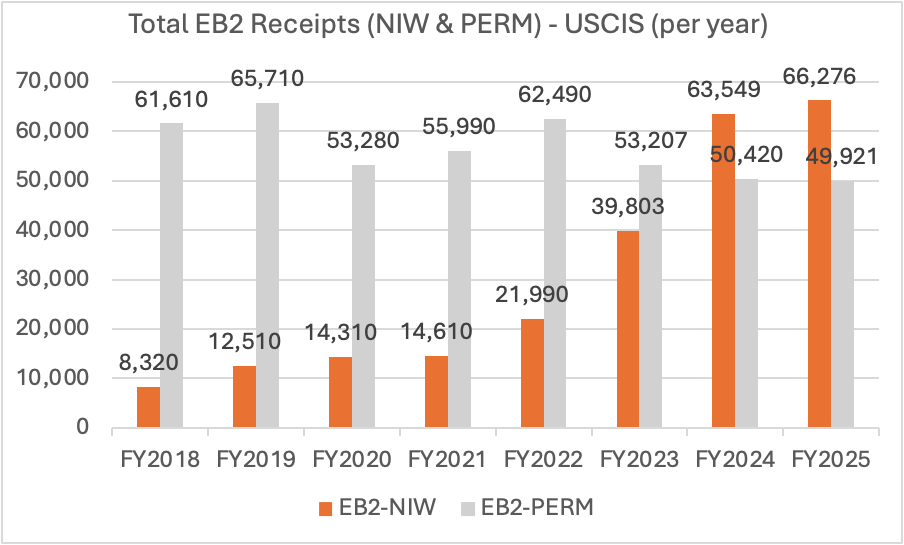
The latest quarterly approval rate of 36% continues a trend of a precipitous drop that began around fiscal year 2023, at the point when filing volumes for EB2-NIW had reached 39,803, nearly a five-fold increase from FY2018 when only 8,320 NIW cases were filed throughout the year.
If we look more closely at quarterly figures, FY2024 saw a steady decline from 76.7% to 61.2%. FY2025 Q1 approval rates started at 62.7%, which fell quite significantly by Q3 to 54.0%, then dipped even lower in Q4 to an all-time low at 35.7%.
Since the beginning of available data from FY2018, it is unprecedented for an employment-based immigration petition category to have an approval rate so low that more cases are being denied than being approved. It is now nearly twice as more likely for an EB-2 NIW petition to be denied than it is to be approved.
The landscape of immigration practice in this area has fundamentally shifted; applicants need to seriously reconsider their strategies and seek the advice of the most well-informed counsel if they are to realistically aim for approval, because old strategies that would have worked just fine just a few years ago will no longer work in today’s adjudication climate.
Reasons behind increasing EB2-NIW denials
To formulate an effective response in the face of these historically low approval rates in the EB2-NIW category, it is critical to understand the possible reasons that may explain this change of adjudication approach within USCIS.
An important context to take note of in understanding this phenomenon is the exponential increase in EB2-NIW filing volumes over the past few years, especially in comparison to the volume of PERM filings. As the graph illustrates, in FY 2018 the vast majority of EB2 filings were PERM filings at 61,000, and the total number of NIW filings were only about 8,000. By FY2025 we see a completely different picture. EB2 NIW filings now outnumber EB2 PERM filings by a wide margin, with the total for EB2-NIW filings for FY2025 at 66,000, compared to 49,921 for PERM filings. Especially since FY2022, we’ve seen a near-doubling of NIW filings each year.
A few significant movements in the past few years may have motivated this exponential increase in EB2-NIW filings:
- The first phenomenon is that PERM processing times have elongated significantly, rendering the PERM process a marathon spanning multiple years. Along with this, we’ve seen high-volume EB2-NIW filings from large tech companies filing en masse on behalf of their engineers in search of a quicker alternative to PERM.
- The second factor is that the EB2 NIW, being a category that allows self-petitioning, has been subject to a growing misunderstanding among the public as being a “Do-It-Yourself” type of green card, and a proliferation of DIY petition kits and non-lawyer advice from online forums has encouraged many hopefuls to try at self-filing a petition, even if the case is weak or not viable.
- The third significant change is the introduction of premium processing for the EB2 NIW in 2023, which now allows petitioners to receive an answer within 45 business days, whereas regular processing takes over a year. This made the EB2 NIW a much more attractive option, alongside the EB1A, as a fast-track pathway for an I-140 approval.
In any case, these dramatic increases in EB2-NIW filing volumes would have spurred USCIS to action, especially in comparison to the decreasing volume of PERM filings. Considering that the PERM labor certification process was legislated as the “default” pathway for employment-based green cards and the NIW reserved for “special” cases where an exemption may be granted if the particular case is in the national interest, the fact that the intended exception has now outnumbered the default – 57% of EB2 cases now being filed as NIW cases and 43% being PERM according to FY2025 numbers – may have motivated USCIS to do something to flip the balance back towards favoring PERM as the default.
The fact that EB2-NIW is by nature a discretionary benefit makes it easier for USCIS to defend a denial. This may explain why the EB2-NIW approval rates have reached these abysmal lows of 36%, which is unparalleled in any other type of employment-based nonimmigrant or immigrant visa category. The NIW adjudicatory framework set out in Matter of Dhanasar is written in language that inherently involves a degree of subjective and qualitative judgment, such as “significant” prospective impact,“substantial”positive economic impact, and “broad” benefit to a field or nation. There is no bright-line rule on what counts as a significant, substantial, or broad impact, giving significant discretion to USCIS to decide what that means for the government. AAO opinions and anecdotal reports of Request for Evidence (RFE) and denial patterns indicate the USCIS is indeed using a very high standard when they make judgments on what is substantial, significant, or broad. As such, it is of paramount importance to consult the advice of a lawyer who is deeply knowledgeable regarding the nuances of these legal adjudication trends to get a good sense of the realistic chance of success on a particular case and optimize the framing for your case. Use of outdated strategies, AI-generated template letters, and suboptimal case presentation is no longer a way to cut corners; each of these is now a critical mistake that will lead an officer to immediately dismiss your case.
Potential Response Strategies
Many prospective applicants who were considering, or preparing for, EB2-NIW among possible options for obtaining a green card may be disappointed and concerned that recent adjudication standards have significantly tightened. Especially if your case is on the weaker end, what strategies could you explore?
Switch to E-2 or O-1A and take a longer term approach towards building evidence for a more compelling NIW case
A careful case approach is now needed especially for entrepreneur cases. With the publication of the updated 2025 policy manual section pertaining to EB2-NIWs, USCIS has made their intent very clear that not all entrepreneurs will be approved for an NIW, and a localized benefit of creating just a handful of U.S. jobs and revenues typical for a small business will not be sufficient on its own to rise to the level of national importance.
In this climate, entrepreneurs who are treaty country nationals may want to explore changing status (or obtaining a visa) to E-2 first and spend several years further developing the business and collecting additional evidence that may support a finding that the business’s offerings may broadly impact the advancement of the field as a whole, such as by developing and disseminating a new cutting-edge technology that can be licensed or used by others in the field. The advantage of the E-2 visa is that there is no lifetime limit on how many years an entrepreneur can stay on the E-2 visa, as long as they continue to meet the E-2 requirements.
For entrepreneurs who are not treaty country nationals but have made significant contributions to their field and received renown may consider the O-1A visa as a temporary pathway. Like the O-1A visa, the O-1A visa also does not have a lifetime limit and can be extended for as long as there is continued demand in the U.S. for the beneficiary’s services in their area of extraordinary ability.
In this time working in the U.S. on a temporary visa such as the E-2 or O-1 visa, if the applicant is able to collect more powerful forms of evidence of influence in their fields and develop connections with U.S. government agencies and leading industry actors that express interest in their proposed endeavor, a subsequent EB2-NIW petition would be more likely to succeed.
Explore alternate green card pathways, such as PERM, EB-5, or EB-1B.
With EB-2 NIW standards tightening significantly and the inherent uncertainty of the EB2-NIW being a discretionary benefit adjudicated under relatively subjective and qualitative judgments (such as what impact counts as ‘significant’), it may be a prudent choice for applicants to pursue parallel strategies to explore PERM options (employer sponsorship) and other pathways to explore alongside preparing for an EB2-NIW case, such as an EB-5 investment based immigrant petition.
It is important to note that there can be multiple employment-based petitions being pursued at the same time. For example, an applicant may have an EB-5 Immigrant Investor petition pending, and simultaneously submit an EB-2 NIW petition if they may be eligible for both. Any of the pending petitions, once approved, can be used as a basis to apply for the green card.
The PERM employer sponsored green card pathway, in particular, has become less popular in recent years than before due to lengthening processing times, but may be worth re-visiting as qualifying for the EB-2 NIW is becoming more and more difficult and realistically out of reach for many applicants. Especially for applicants who are professionals in industry, such as engineers who typically work for a company, PERM may be a more straightforward and viable option if they can find a willing employer sponsor. The main difficulty with the PERM option is the lengthy processing times, so it may be a good idea for applicants to plan ahead and start the sponsorship conversation early in their relationship with an employer. The EB-2 NIW could then be considered as a potential option to speed up the waiting, but the applicant could approach the process with more security if they already have the PERM process ongoing in the background.
Data source for all charts in this article: USCIS, Tools, “Immigration and Citizenship Data,” https://www.uscis.gov/tools/reports-and-studies/immigration-and-citizenship-data (retrieved April 2026).